Six sections, one cohesive story: wireless intelligence evolves into an AI-automated, self-securing network platform.
Access point architectures spanning Edge, Campus, High-Density, and Next-Gen Wi-Fi 6E/7.
Adaptive TX Power, SmartRF, OFDMA, AirDefense, Per-Packet Modulation, and Transient Client Management.
Universal switching hardware spanning smart-managed edge (4120/4220) to 400G DC core (7830).
Appliances scaling from branch edge (1130C) to large-scale managed deployments (3160C).
AI Core (Expert, Canvas, Agents), Zero-Touch Fabric, Universal ZTNA, Composable Workspace & 1:1 Licensing.
Tracing a single packet from user device to cloud continuum with automated AI operations.
Instead of a spec table — the portfolio organized by where and how it's deployed. Click a category.
Every model below is sourced from Extreme's datasheets. Confirmed / Corrected / Needs Verification flags carry over from the source catalog — click a model for full radio and connectivity specs.
The AP doesn't broadcast at one fixed power in every direction — it continuously adjusts how much power it uses and how it shapes that signal.
Dynamically raises or lowers each radio's transmit power, and shapes the signal using both horizontal and vertical antenna polarization.
The AP monitors neighboring APs and client signal levels, then recalculates power per radio. Separately, H/V polarized antenna elements combine to match how a client device is actually held or positioned.
Fixed, maximum-power APs overlap neighboring cells, waste airtime, and lose signal when a client's antenna orientation doesn't match a single-polarization antenna.
Cleaner, non-overlapping coverage cells and more consistent throughput regardless of how a device is oriented.
A phone held to your ear and a laptop lying flat on a desk present very different antenna orientations to the AP — H/V polarization diversity keeps signal strength consistent for both.
RF conditions change constantly. SmartRF observes and adapts before performance suffers.
Continuously and automatically manages channel allocation, channel width, and transmit power settings across every AP in the deployment.
SmartRF monitors neighbor AP signals, client signal quality, co-channel interference, and coverage holes, dynamically re-tuning RF settings in real time without dropping active clients.
Static RF plans go stale as physical environments and client densities change, leading to co-channel interference, coverage dead zones, and degraded roaming performance.
A self-healing, self-optimizing wireless network that delivers predictable high performance and zero-touch continuous operation without manual RF site surveys.
Simulated dashboard — click to watch SmartRF detect congestion and move to a healthier channel.
Channel 6 is congested. Click to watch SmartRF move to a healthier channel.
Orthogonal Frequency Division Multiple Access — one channel, many simultaneous conversations.
Divides a Wi-Fi channel into smaller Resource Units so multiple devices can transmit and receive at the same time.
The AP allocates specific frequency sub-channels (RUs) to different clients within the same transmission opportunity, sized to how much data each one needs.
Traditional Wi-Fi lets only one device use the whole channel per transmission, so many small or simultaneous transmissions (IoT sensors, VoIP, etc.) queue up and waste airtime.
Lower latency and higher effective capacity in dense environments with many simultaneous devices.
See how the channel splits differently depending on how much traffic each device needs.
A wireless intrusion detection and prevention system that watches the RF layer itself.
Continuously monitors the RF environment for wireless-layer security threats — rogue APs, spoofed SSIDs, unauthorized devices.
AirDefense detects the threat, classifies it, and can automatically contain it by preventing clients from associating with it — no manual intervention required.
Rogue or unmanaged wireless devices can create backdoors into the network or intercept traffic, and wired security tools can't see wireless-layer threats.
Continuous, automated wireless threat detection and containment — instead of waiting on periodic manual security audits.
Not every packet gets the same treatment — the AP picks the best modulation for each one, individually, in real time.
Selects the optimal modulation and coding scheme independently for every single packet, rather than fixing a rate for an entire session.
Before each transmission, the AP evaluates current signal quality and switches between simpler, more robust modulations and denser, faster ones as conditions allow.
Session-level rate selection can't react to microsecond-level RF fluctuations, leading to either overly conservative speeds or too-aggressive rates that cause retransmissions.
Every packet gets the fastest reliable delivery the RF conditions allow at that instant — maximizing throughput while minimizing retransmissions.
"Start conservative — get the packet through reliably."
"When conditions allow, pack in more data per transmission."
"The right modulation, every packet, every time."
Not every nearby device deserves the same attention as one that's actually connected.
Identifies devices that repeatedly probe or briefly connect without becoming genuinely associated clients, and deprioritizes them.
The AP recognizes transient/passerby probing behavior and reduces the airtime and processing given to those devices, favoring sustained, authenticated clients.
In busy areas — lobbies, open floors near public space — large numbers of nearby but non-associated devices still consume AP airtime with constant probe requests.
Real, connected users get consistently better performance because the AP isn't wasting resources chasing devices that were never going to connect.
Simulated probe field — activate Transient Client Management and watch the effect.
52 models, sourced from Extreme's official datasheets — grouped by series. Click a model for the full port, PoE, stacking, and capacity breakdown.
Endpoint → Access → Distribution → Core → Data Center
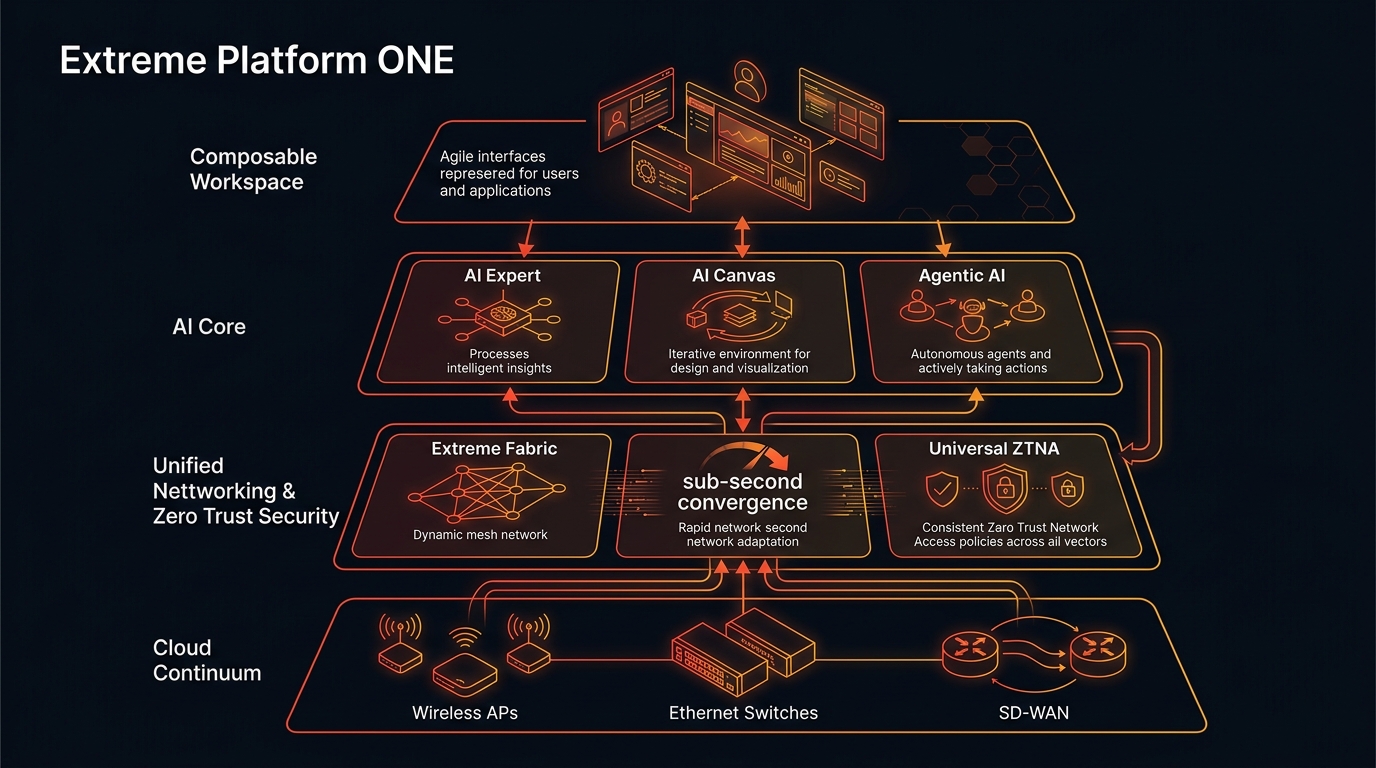
The industry’s first all-in-one networking platform with integrated zero trust security and conversational, multimodal, and agentic AI.
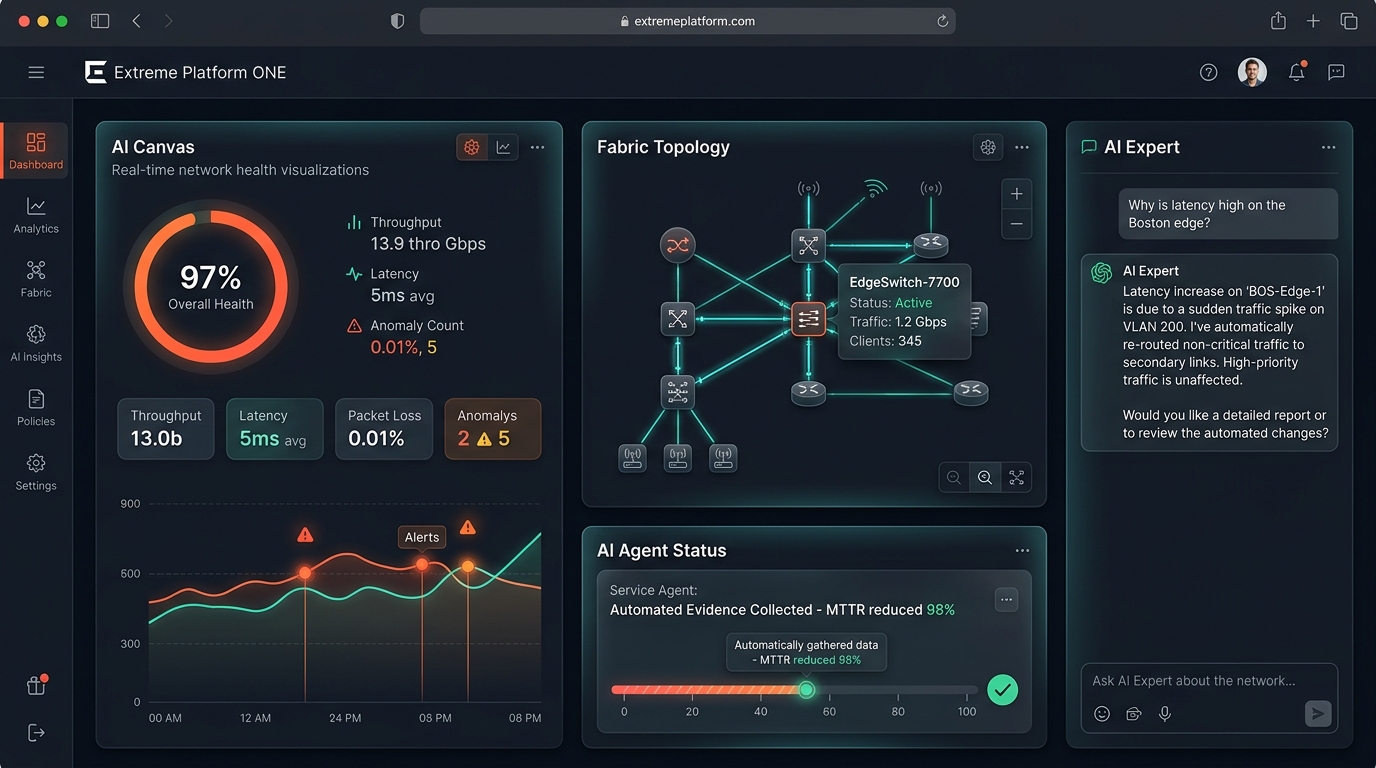
Unlike siloed AI tools, Platform ONE integrates conversational answers, custom visualization dashboards, and autonomous agent workflows.
Pre-integrated networking and security eliminate complex integrations — delivering stealth core protection and identity-based access anywhere.
See how bad actors view traditional networks versus Extreme's invisible fabric topology.
Turning 8 clicks into 1 with multi-domain, multi-layer visibility, personalized workspaces, and accelerated onboarding.
Composable workspace ensures admins find telemetry, configure policies, and inspect nodes in 2 clicks or fewer without bouncing across screens.
Switch between Geographic, Logical, Access, RF Maps, Fabric, and Service views for Extreme and 3rd-party devices with real-time alert overlays.
Hierarchical site scoping (Site Groups → Sites → Buildings → Floors) and zero-touch bulk device claiming across wired and wireless hardware.
Built-in hardware lifecycle monitoring, proactive compliance risk alerts, subscription tracking, and instant contract renewal workflows.
Interactive world/regional map plotting all distributed campus, branch, and data center locations. Side-by-side alert overlays immediately highlight degraded sites with full drill-down to building floor plans in 1 click.
1 Hardware SKU + 1 Software Subscription SKU. No complex bills of materials, no hidden software fees, and 100% in-sourced GTAC support included.
| Tier | Wireless Hardware | Wired Switching Hardware | Available Terms |
|---|---|---|---|
| Tier A | All Indoor & Outdoor APs (AP3000, AP4000, AP5020, AP5050, AP5060) | 4100, 4200, 5100, 5300 Series Switches | 1 (Flexible), 3, 5 Years |
| Tier B | — | 5400 Series Switches (5420F, 5420M) | 1 (Flexible), 3, 5 Years |
| Tier C | — | 5500 Series Switches (5520 Series) | 1 (Flexible), 3, 5 Years |
| Tier D | — | 5700, 7500, 7700 Series Core/DC Switches | 1 (Flexible), 3, 5 Years |
Select your target hardware to generate the exact 1:1 hardware and subscription SKU pairing:
Follow a single packet as it traverses the entire Extreme intelligence stack — self-optimizing, stealthily transported, zero-trust validated, and continuously analyzed by AI agents.
Traffic originates. Universal ZTNA continuous posture checking verifies client health and identity with Microsoft Entra / Google Workspace.
Adaptive TX Power, H/V polarization beamforming, SmartRF, and OFDMA transmit the packet with Per-Packet rate selection while Transient Client Management shields airtime.
Auto-sensing 802.3bt PoE++ port powers the AP, dynamically assigns VLANs via Cloud NAC, and enforces local rate limiting.
The packet is encapsulated into an SPB stealth fabric. Core switches remain invisible to IP scans; sub-second convergence guarantees zero packet loss during link failovers.
Just-in-time micro-segmentation routes application traffic securely across encrypted WireGuard / IPsec tunnels with least-privilege access rules.
Real-time telemetry feeds AI Canvas. 24/7 AI Service Agent detects micro-anomalies, self-heals bottlenecks, and logs diagnostic evidence — cutting MTTR by 98%.